Sub-250ms Latency and 1M Token Context: Decoding Supermaven and Custom Fast Transformers
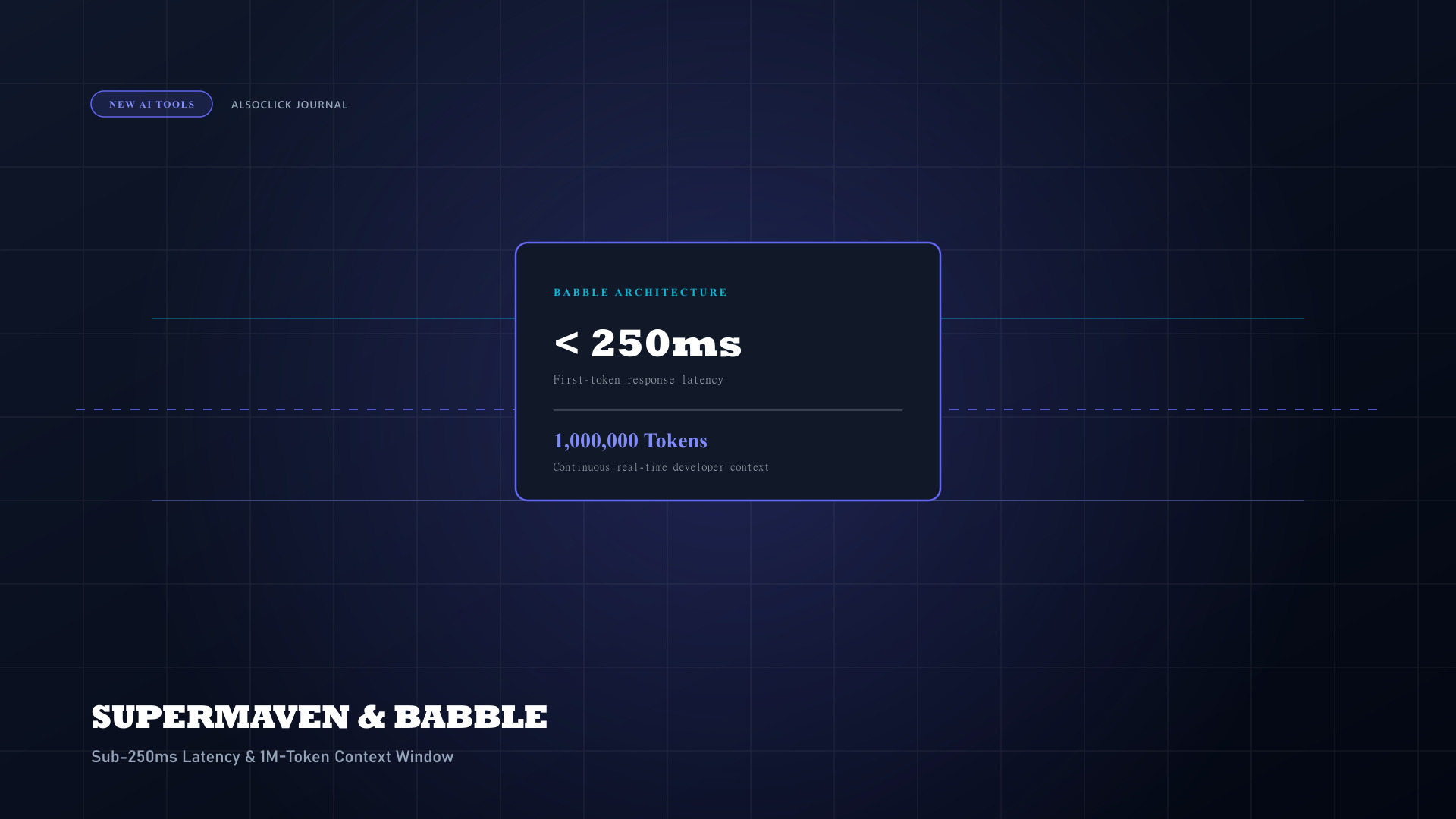
In the world of AI code autocomplete, speed is everything. Human developers type at rates between 60 and 120 words per minute. If an AI autocomplete suggestion takes 800 milliseconds or longer to appear on screen, it disrupts typing flow, causing developers to ignore or disable the extension entirely.
Created by Jacob Jackson (creator of Tabnine), Supermaven solved this fundamental latency bottleneck through a custom neural network architecture dubbed Babble. By combining sub-250ms response times with an astounding 1,000,000-token context window, Supermaven redefined code completion expectations—culminating in its September 2024 acquisition by Cursor (Anysphere).
---
1. The Quadratic Attention Dilemma in Long-Context Coding
Standard Transformer architectures utilize self-attention mechanisms with quadratic computational complexity $O(N^2)$ relative to sequence length. As a result: - Ingesting a large codebase (500,000 tokens) causes traditional models to choke on memory bandwidth. - Time-to-first-token (TTFT) stretches to several seconds. - Hosting costs skyrocket, making real-time per-keystroke inference economically unsustainable.
---
2. Inside the Babble Architecture
Supermaven abandoned off-the-shelf LLM architectures in favor of Babble, a neural model designed from first principles for code prediction:
- Ultra-Efficient Custom Attention: Babble utilizes specialized sparse attention and recurrent state-space mechanisms that dramatically reduce memory footprints, allowing active context windows to scale to 1,000,000 tokens.
- Speculative Verification & Caching: Because developers edit code incrementally, Supermaven maintains a persistent, rolling KV-cache of the open project. When a developer types a character, the model only computes the delta, emitting accurate next-token completions in sub-250 milliseconds.
- Full Repository Memory: The 1M-token window allows Supermaven to hold dozens of open files, database schemas, API documentation, and recent commit diffs simultaneously in active memory.
---
3. The Cursor Acquisition & Future Integration
In September 2024, the engineering team behind Cursor announced the acquisition of Supermaven, combining Supermaven's ultra-low-latency autocomplete engine with Cursor's multi-file Composer interface.
This integration delivers two distinct layers of AI assistance within a single IDE: 1. The Fast Loop (Supermaven/Babble): Operates at <200ms on every keystroke, predicting complex syntax patterns, variable names, and closing brackets before the developer finishes typing. 2. The Deep Loop (Composer/Claude/o1): Operates asynchronously when the developer requests architectural refactors or multi-file feature implementations.
---
4. Why It Matters
Supermaven proved that specialized, domain-tailored neural architectures can dramatically outperform massive general-purpose models on latency and efficiency. By conquering the 1M-token context threshold at human-reflex speeds, Supermaven has set the technical standard for the next generation of developer productivity tools.
---