Anthropic Claude Computer Use: How Foundation Models Are Learning to Navigate GUIs and Desktops
For decades, automating desktop user interfaces required rigid, brittle scripts: Selenium test suites that fail when a CSS class updates, or robotic process automation (RPA) tools that break when a pop-up window moves five pixels to the left.
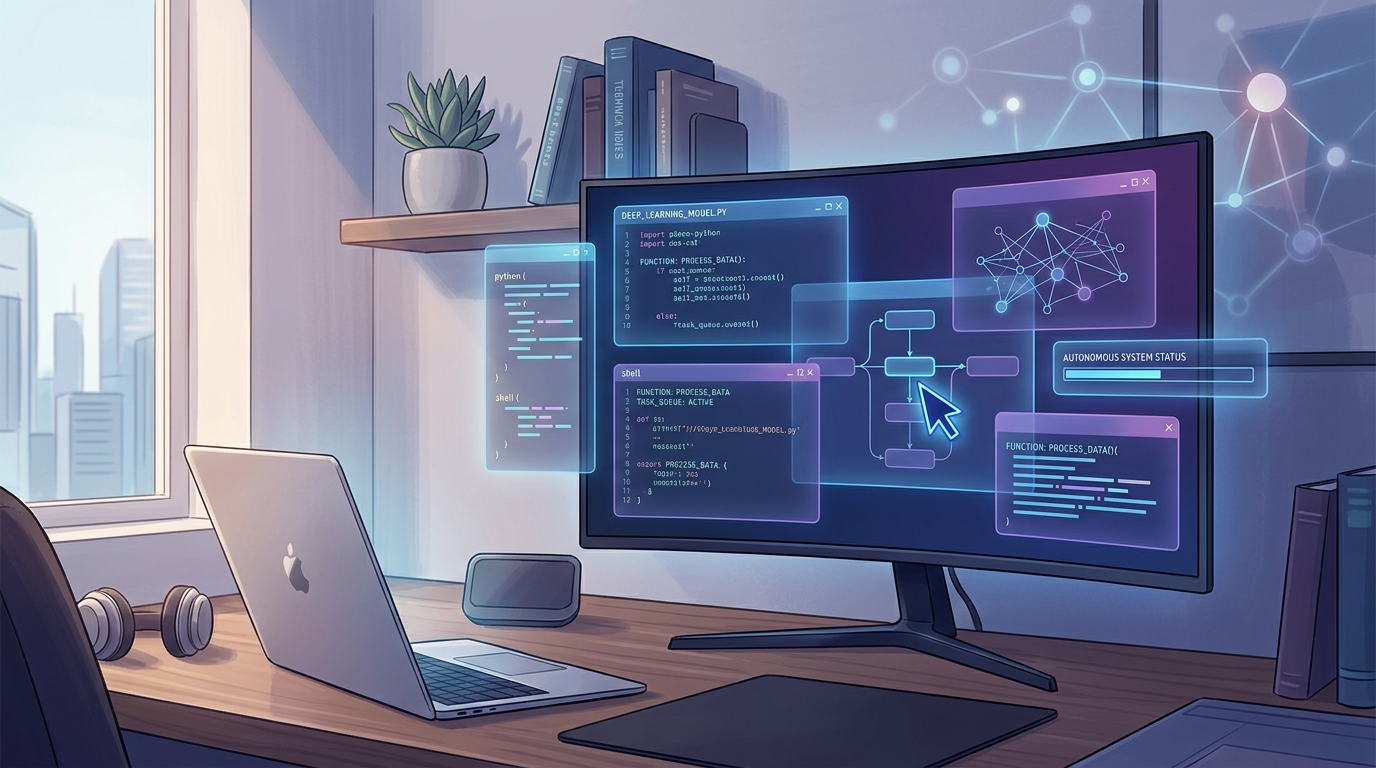
On October 22, 2024, Anthropic introduced a paradigm shift with the public beta release of Computer Use for Claude 3.5 Sonnet. Rather than relying on custom APIs or reverse-engineered DOM trees, Claude interacts with computers the exact same way human beings do: by observing pixels on a screen, planning intermediate spatial steps, moving the cursor, clicking buttons, and typing keystrokes.
---
1. How the Computer Use API Works Under the Hood
The Computer Use API introduces a closed feedback loop between the client application and Claude's multimodal vision encoder:
1. Screen Capture: The host client takes a screenshot of the desktop or virtual container and sends the raw image tokens to the Anthropic API.
2. Visual Decomposition: Claude identifies active windows, input fields, navigation menus, and buttons, calculating their precise Cartesian $(x, y)$ coordinates.
3. Action Token Emission: Claude emits a structured tool call selecting an atomic action:
- mouse_move: Moves the cursor to target coordinates $(x, y)$.
- left_click, right_click, double_click: Triggers physical mouse button events.
- type: Emits keyboard strings into focused form fields.
- key: Fires system shortcut chords (such as Ctrl+C, Cmd+Shift+P, Enter).
- screenshot: Requests a subsequent display frame to verify that the previous action produced the intended outcome.
4. Execution & Feedback Loop: The client executes the action via native OS automation libraries (like xdotool or pyautogui) and streams the resulting screenshot back to Claude to confirm success or correct errors.
---
2. Benchmark Reality: The OSWorld Evaluation
To rigorously quantify autonomous desktop capabilities, Anthropic benchmarked Claude 3.5 Sonnet against OSWorld, an open environment testing multimodal agents across diverse operating system tasks (spreadsheets, browser research, LibreOffice formatting, and software installation).
| Agent Architecture | OSWorld Task Success Rate | Human Benchmark | | :--- | :--- | :--- | | Baseline Multimodal LLMs | 2.1% – 7.8% | 72.4% | | Claude 3.5 Sonnet (Computer Use Beta) | 14.9% (and up to 22.0% with self-correction) | 72.4% |
While a ~15-22% success rate demonstrates that fully unsupervised general automation is still nascent, it represents a nearly 3x leap over prior state-of-the-art models. Tasks with clear UI cues—such as booking calendar slots, extracting data from desktop spreadsheets, and executing git commands in terminals—reach significantly higher completion rates.
---
3. Security, Sandboxing, and Failure Containment
Giving an autonomous foundation model mouse and keyboard control carries significant inherent risks: prompt injection from malicious web pages, accidental file deletion, or unauthorized financial transactions.
Production deployments must implement three strict architectural safeguards: - Ephemeral Isolated Containers: Always run computer use agents inside dedicated Docker containers or virtual machines with zero access to production host filesystems. - Network Egress Filtering: Restrict outgoing HTTP/HTTPS connections to whitelisted domains to prevent data exfiltration via untrusted third-party endpoints. - Human-in-the-Loop Confirmation Gates: Require explicit human approval whenever the model attempts irreversible operations, such as credit card checkouts, database drops, or sending external emails.
---
4. Why It Matters
Computer Use represents the bridge between modern generative AI and the vast majority of software that has never possessed an API. Instead of waiting years for enterprise vendors to construct programmatic integrations, AI agents can now pilot legacy software, desktop accounting suites, and proprietary internal dashboards directly. As accuracy benchmarks inevitably climb from 15% toward human parity, desktop operating systems will increasingly be navigated by autonomous software agents acting on high-level natural language instructions.
---