The Shift to Inference-Time Compute: How OpenAI o1 Rethinks Complex Problem Solving
For over six years, the dominant scaling paradigm in generative artificial intelligence was predictable: train larger models on larger token datasets using larger GPU clusters. While pre-training scaling laws yielded astounding progress from GPT-2 to GPT-4, frontier labs have encountered diminishing returns in standard cross-entropy loss alongside soaring training expenses.
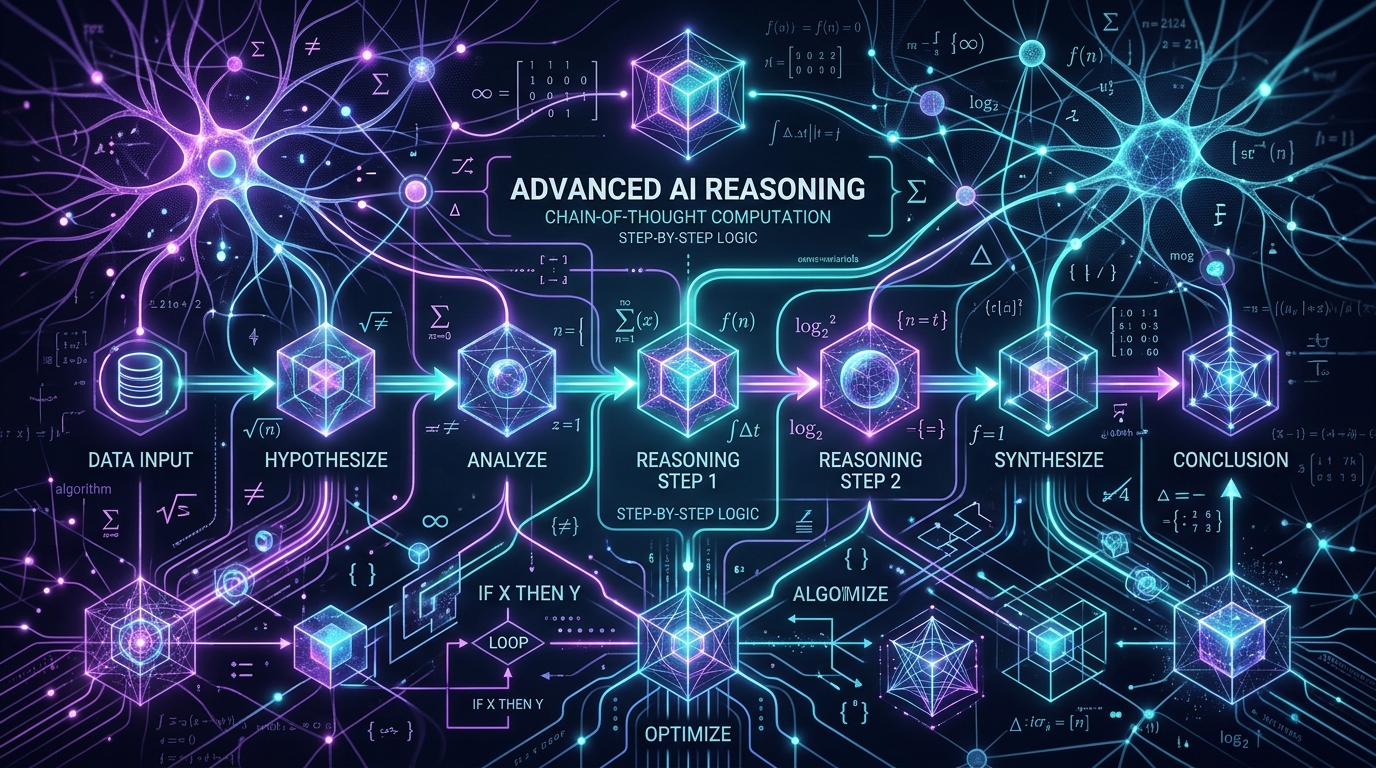
With the release of the OpenAI o1 reasoning series (formerly codenamed *Strawberry*), the AI industry has officially embarked on a second dimension of scaling: inference-time compute. Instead of attempting to produce an immediate token-by-token answer within milliseconds, o1 generates an internal, structured chain of thought before emitting its final response.
---
1. What Is Inference-Time Compute?
In traditional autoregressive models, inference cost per token is fixed by the parameter count of the model weights. The model has the same computational budget whether predicting a punctuation mark or proving a mathematical theorem.
Inference-time compute changes this dynamic fundamentally. By employing reinforcement learning with verifiable rewards, o1 is trained to: - Formulate initial hypotheses and outline solution steps. - Backtrack and correct missteps when an intermediate deduction fails logical validation. - Decompose multi-step constraints into atomic, checkable sub-problems. - Weigh alternative strategies before committing to an output.
Crucially, the user pays for the tokens spent in this hidden reasoning scratchpad. The more complex the question, the longer o1 "thinks," unlocking a continuous tradeoff between inference latency and cognitive accuracy.
---
2. Benchmark Breakthroughs: Math, Code, and Science
The performance divergence between traditional LLMs and reasoning models is most pronounced in domains with objective ground truths:
| Benchmark Domain | GPT-4o Baseline | OpenAI o1 Performance | Human Expert Reference | | :--- | :--- | :--- | :--- | | AIME 2024 (Math Olympiad) | 13.4% | 83.3% | Top 500 US High Schoolers (~12.5/15) | | Codeforces (Competitive Programming) | 11th percentile | 89th percentile | Competitive algorithmic coders | | GPQA Diamond (Ph.D. Science QA) | 56.1% | 78.0% | Domain experts with PhDs (69.7%) | | MATH Benchmark | 76.6% | 94.8% | Elite STEM undergraduates |
These results illustrate that tasks requiring multi-step planning and deductive verification—which previously resulted in hallucination loops—can now be solved reliably when models are afforded inference compute budgets.
---
3. Practical Implications for Developers and Engineers
For software engineers, data scientists, and builders on AlsoClick, o1 represents a strategic shift in when and how to deploy frontier models:
When to Use Reasoning Models: 1. Algorithmic Optimization: Complex dynamic programming, graph traversal, and mathematical modeling where off-by-one errors ruin outputs. 2. Refactoring Monoliths: Analyzing intricate cross-file dependency trees and edge cases in security-critical code. 3. Formal Verification & Law: Dissecting dense contract clauses or regulatory compliance frameworks that require flawless cross-referencing.
When Traditional Models Remain Superior: For conversational customer support, creative copy drafting, UI prototyping, and low-latency autocomplete, traditional models like GPT-4o or Claude 3.5 Haiku remain significantly faster and orders of magnitude more cost-effective.
---
4. Why It Matters
The validation of inference-time compute introduces a dual-axis roadmap for the entire ecosystem. Rather than waiting 18 months for multi-billion-dollar pre-training runs, engineering teams can achieve frontier-grade reliability today by allocating compute at runtime. As specialized reasoning models proliferate across open-weights and proprietary offerings, the definition of an AI "assistant" is rapidly transitioning into an autonomous analytical partner.
---